On our network, we have a daemon that continuously port scans all our PCs - basically attempts to hack them and reports any vulnerability it finds. I used to be really impressed with the idea; until I saw some of its reports. Here's the latest.
I get a report of a critical security vulnerability and warning me that if I did not fix it immediately, my system would be disconnected from the network. The synopsis of the problem? "It was possible to access the Windows Registry remotely on your system". Very interesting, especially given that my computer runs Fedora Linux.
The network security people, of course, have no clue why this is coming up. Any Linux geeks out there who have any idea? Is this a Fedora Core 4 easter egg by any chance?
Wednesday, January 25, 2006
Friday, January 20, 2006
I Dare! - Kiran Bedi A Biography by Paramesh Dangwal
 In a 2002 poll, Kiran Bedi was adjudged by "The Week" magazine to be the most admired woman in India. After reading this book, I was not at all surprised. For a woman who starred at tennis and managed to get fame even as a traffic cop, her achievements spanning crime prevention, police training and being an advisor to the UN have only become greater.
The popular myth - that nothing can be done about the inefficiency, lethargy and corruptibility of Indian government service - gets powerfully dispelled. Throughout much of her career, Kiran Bedi has done nothing but get more service and productivity out of the staff that were assigned to her. From changing the traffic situation in Goa with a mere 25 cops to getting the respect of the outsider-unfriendly state of Mizoram as Police Commissioner, her ability to marshall her resources shines through. What's amazing is that it often took just this one person, and maybe a few others to cause massive changes in the police systems and operations. I began to believe at the end of the book that the critical mass required for change - even in a system that can be as rotten as the indian civil service - is not so huge after all.
This is basically a book about leadership. Leaders basically act as catalysts for positive change. While today leadership in literature is mostly about CEO's, the magnitude of social change that Kiran Bedi has started is (to me) much more impressive than that. One of her famous postings was as Inspector-General of Tihar Jail in Delhi. Before she arrived, it was known to be a hellhole. Drugs, physical abuse, corruption, disease, prisoner deaths were common. In the short span of two years, she converted the prison into "virtually an ashram" in the words of the press - which in involved man-management of over 8000 prisoners and hundreds of staff - all of whom were beset by common problems. The book tells the story of the innovative methods - mostly rehabilitation and correctional efforts managed to change a place like Tihar in such a short span of time. Another aspect of undaunted leadership is that Kiran Bedi often found huge opposition from politicians and others who didn't like her making changes to the system - and she manages to accept these realities and still carry on her work at the same time.
Kiran Bedi herself is the author of four books and runs two voluntary organizations - Navjyoti and India Vision, and has a PhD from IIT Delhi in Social Sciences.

Saturday, January 14, 2006
India vs. Pak - 1st Test, Day 1
I hope Team India has got the message. This is not the Pakistan team we played in 2004. I watched every ball of today's play and that fact is imminently clear.
The pitch, of course, is flat - perfectly suited to batting. That fact only partly explains the scorecard at the end of the day's play (326 for 2). The other factor is that Pakistanis seem to have turned into something they were hardly ever accused of - professional, solid cricketers. You miss so much of a test match if you simply follow it online or watch highlights. While there was little assistance for swing or bounce from the pitch today, the Indians did bowl very tightly in the first session and to some extent, the second. Younis Khan and Mohd. Yousuf were shining examples of "playing the ball on its merits". The number of good balls they went after were few and far between, and any loose balls - Kumble bowled quite a number - were dispatched. The Pak team of two years ago might easily have lost six wickets under the same conditions - because they appeared then to be a team without a plan, the only visible intent was to go out and bat. Today was a whole different story. If today's attitude is a trend, we will find it very very difficult to win this series.
As far as the Indian bowling is concerned, there is just one word to describe it - lacking in ability, as both Imran Khan and Sanjay Manjrekar put it. On a pitch like this, they can do precious little to get wickets except hope for the batsmen to make a mistake. Pathan and Agarkar are painfully slow only around 80 mph, and without bounce or appreciable swing, their good balls are easy to defend and the bad ones easy to hit. A question asked in the discussion is a very good one - why has it been ages since India had a genuine pace bowler? Can it be that among the millions of people who play competitive cricket in India - there are no good genuine pace bowlers? Agreed pitches in India are not suited to seamers - but on a surface that lacks pace and bounce, a bowler who's just plain fast should theoretically do better than people like Pathan or Agarkar who aren't fast but can achieve decent swing and bounce if assisted by the pitch. But I digress. With four specialist bowlers, and only two seamers; its painfully obvious that we are not going to make an impression on Pak pitches. Zaheer should have been played, not just to give Dravid more options but to explore and get the seamers used to the conditions - you cannot expect to win a series in Pak without a good pace attack. We have quality spinners for wickets that turn - if they can't do much in Pakistan (and it was quite clear they can't), then both spinners have no business being in the playing eleven.
Lets see how things go tomorrow. Pakistan are looking at a declaration after 600. Looks likely that we'll get one or half a session tomorrow to bat. It will be good to compare Pak's pace attack against ours.
Tuesday, January 10, 2006
Cricketing music
One of the many wonderful things about being in India. Five sports channels. The crucial part is - at any given time, at least two will be showing cricket. I've been home for three days and all three nights, I've slept off watching cricket at night. No better lullaby than "Thats an excellent drive.. he came to the pitch of the ball and excellent transfer of weight into the shot..."
Can't wait for Friday morning - I cannot remember the last time I saw an India-Pak test match at home.
Can't wait for Friday morning - I cannot remember the last time I saw an India-Pak test match at home.
Thursday, January 05, 2006

Research topics in Computer Science
I recently got an email out of the blue from somebody asking me to suggest a topic for a PhD in Computer Science. I can only think of three responses to such a question.
The instinctive response, of course, is to tell the person to go consult an astrologer - whose input I figure will be much more useful than mine. Hey, at least it won't be totally random.
The second response is the truly random response. Think of the most complex terms in Computer Science and plug them together to concoct a topic. Fortunately, this is something that a charitable soul at Purdue has already done.
The third response can be classified in the "smart-alec" category. Simply return with a list of all possible topics in Computer Science which squarely puts the ball out of your court. Also guaranteed to cause complete confusion in the best case and mental degeneration in the worst.
Probably a fitting way to sum it up would be to borrow the Oracle's dialogue from the Matrix: "You seem like a nice guy, and I hate giving good people bad news."
Wednesday, January 04, 2006
Java vs. C
Joel Spolsky, recently wrote an article talking about the dangers of letting CS courses in universities move to Java from C, Scheme or Lisp. I'm not sure I agree with that point of view entirely.
His basic claim is that "Java is not, generally, a hard enough programming language that it can be used to discriminate between great programmers and mediocre programmers." The reason? From his point of view, the Gods of programming are those who are familiar with two main things - pointers and recursion. Since Java doesn't have pointers and most Java courses or programs don't bother about recursion, he thinks dumb people can find it easy to write in Java. He believes C or scheme or lisp is needed to "weed out" the dumb programmers.
Here's my perspective - as a programmer, I am quite comfortable with pointers. I just rewrote (ported) a piece of MATLAB code to C, line by line, and since it was full of matrix operations, it was full of pointers. I have implemented pointer-based hashtables, written geometric collision-detection code using pointers and grids of pointers; and I was happy doing it. I've even done some assembly language programming on DSP chips. That was tough, no doubt about it, but given that I did it when I was basically a novice, its not all that bad. I've been programming on Java rather irregularly (I'd much rather code in C++ any day), but I've done complex projects like compiler design or AI implementations in Java. And I still find it hard to design and write a good program in Java.
Here's my take on pointers. They're boring. I use them all the time, and yes, your program will segfault and give you weird errors. Most people believe that debugging that requires some kind of great depth in understanding. It does not. All it requires is patience, attention to detail and caffeine. Its a process of following the thread of reference changes until you find the bug. You learn from your mistakes when your mistakes are in concepts or fundamentals. With pointers, mostly the mistake is you incremented the wrong value, or added something when you should have subtracted. Nothing very profound.
I must admit I missed Joel's point about recursion. Probably thats because I don't know Scheme or Lisp, which deal very specifically with recursive programs. I've implemented identical recursion routines in C and Java (depth-first search and dynamic programming problems come to mind) and the difficulty level has been exactly the same.
There is no doubt that using a lower-level language results in more frequent errors. But is a good programmer one who works on the most error prone language? Even an expert C programmer will screw up at times, and probably more than an expert Java programmer, because pointers are inherently error-prone. If all you want is for a programmer to be able to write difficult code, why C? Why not ask all the schools to train people with punch cards and machine language programming? Clearly we don't want to do that - we know we can eliminate a lot of errors by using higher level languages. And then people talk about knowing the basics. Sure, an implementing a linked list using pointers does illustrate the concept behind it. Any CS 101 course (including that in a Java School) will do the same, and the "bright" kid should not need to painfully work at pointers to understand what the relative merits are of various data structures. In my C class my professor reminded us, "You should all implement a pointer-based linked list. Exactly once in your life. After that, use the libraries."
Joel speaks of 6.001, an extremely tough course at MIT that bad programmers are very likely to drop out of. When I met CS undergrads during my stay in MIT recently, they spoke of 6.170 (which is taught in Java) being as tough as 6.001. While Java and C can be used for the same purposes the intent of each language is different. I think people who program in Java are much more proficient in thinking about high-level, large scale software design (enterprise databases for example) and C coders are much more comfortable with aspects of low-level programming (the Linux kernel). So if you want to judge how smart a Java programmer is, asking him about pointers and recursion is perhaps a bad idea; asking him about OO design and looking for the right answers will probably work better.
The bottom line is that training in Java and C gives you slightly different skill sets and I don't think its fair to say that Java is too dumb a language to judge a good programmer by.
Tuesday, December 27, 2005
The Christmas of code
I was mostly working through Christmas. As opposed to the popular public celebrations in Asia during this time, most of America seems to celebrate X'mas at home with family and the streets are all but deserted. The Yuletide spirit did, however, rain down a lot of programming goodies onto me.
I had been searching forever for a good math library for C++ which could provide me things like probability distribution tables, linear algebra and the like, and a couple of days ago I discovered the GNU Scientific Library (GSL). Its an extremely thorough, well-documented and well-implemented library (in terms of API) for C/C++. Its a huge surprise this doesn't turn up if you google for c++ statistical library or c++ numeric computing. It has routines for all kinds of scientific computations from Fast Fourier Transforms to Statistical Distributions to Monte Carlo Integration. An amazing find. Shouldn't they be required to tell you about such stuff in graduate school, if not as an undergraduate?
I finally made myself reasonably conversant with creating Makefiles for gcc. Creating makefiles for your project manually however is difficult since the dependencies inside your code may change and thus play havoc with incremental builds. I could not, however, make myself learn autoconf and automake - for which there's a whole book - next to which the GNU Make manual looks like a short story. I decided instead to try and write a small piece of software which would generate makefiles automatically for simple projects. I ended up writing a small bash script, which I call buildmake, which basically does what I need - takes a bunch of cpp files, resolves header file dependencies and creates a makefile for incremental builds. If you're into that sort of thing, you can check it out here.
To complete the trio, I had been frustrated in my attempts to get Mac OS X to link static libraries with programs (I know, dynamic libraries are the "in" thing, but you try and convince your cluster administrator to give you access to /usr/lib); and I finally figured out the problem which left me kicking myself and (nearly) my laptop. Turns out that for Apple's GCC, the order of linking is important:
Hope you all had a merry Christmas!
I had been searching forever for a good math library for C++ which could provide me things like probability distribution tables, linear algebra and the like, and a couple of days ago I discovered the GNU Scientific Library (GSL). Its an extremely thorough, well-documented and well-implemented library (in terms of API) for C/C++. Its a huge surprise this doesn't turn up if you google for c++ statistical library or c++ numeric computing. It has routines for all kinds of scientific computations from Fast Fourier Transforms to Statistical Distributions to Monte Carlo Integration. An amazing find. Shouldn't they be required to tell you about such stuff in graduate school, if not as an undergraduate?
I finally made myself reasonably conversant with creating Makefiles for gcc. Creating makefiles for your project manually however is difficult since the dependencies inside your code may change and thus play havoc with incremental builds. I could not, however, make myself learn autoconf and automake - for which there's a whole book - next to which the GNU Make manual looks like a short story. I decided instead to try and write a small piece of software which would generate makefiles automatically for simple projects. I ended up writing a small bash script, which I call buildmake, which basically does what I need - takes a bunch of cpp files, resolves header file dependencies and creates a makefile for incremental builds. If you're into that sort of thing, you can check it out here.
To complete the trio, I had been frustrated in my attempts to get Mac OS X to link static libraries with programs (I know, dynamic libraries are the "in" thing, but you try and convince your cluster administrator to give you access to /usr/lib); and I finally figured out the problem which left me kicking myself and (nearly) my laptop. Turns out that for Apple's GCC, the order of linking is important:
gcc -lsomelib code.c will not work, but gcc code.c -lsomelib will. Now, I had tried to export environment variables, copy libraries to all sorts of places, explored unchartered GCC flags, but who would have thought of that! And nope, Google is not your friend if you have this problem either - found this nugget of information in what has now become my favourite book, despite the cheesy name - Mac OS X Tiger for Unix geeks.Hope you all had a merry Christmas!
Thursday, December 22, 2005
Writing a final at MIT
For the first (and likely the last) time today, I took a final exam in MIT.
There was four subjects being examined in the same examination hall, which was inside a large indoor basketball court - very much like some exam halls in NTU (Singapore). There, the similarities end.
MIT admin staff probably select the oldest tables that can still be held together for students to give exams on. I must admit though, it was a pretty large table - about the size of a small dining table for six - and there was a table and two chairs per person. The top of my table had hundreds of marks from geometrical figures to a scrawled "JAK SPAROW WUZ 'ERE" (I sure hope he didn't have an English exam). The metal lining on the side of the top of the table was held together by duct tape in some places. They make sure you'll buy the "Estd. 1861" line. And the tables rocked. Rocked, squeaked and creaked as I wrote on them - matching every stroke of my pen. Sure was a good way to mask the nervous shivering while writing the paper!
A 9 AM exam in Singapore means students get in by 8.30 and there is usually pin-drop silence by 8.45 when the papers start being distributed. At 9 AM today, most students were having breakfast on the aforementioned tables. Coffee, yoghurt and bagels were the most popular choices. One guy was sitting surfing on his laptop, the staff (lecturer and TAs) had just about come and settled down. I was already beginning to like the atmosphere (except that I was feeling hungry and had never dreamed of getting breakfast to an exam hall).
One girl walked in to the exam hall dragging one large and one medium trolley suitcase behind her. Someone asks the question that was begging to be asked, "open book exam?" Turns out it was, but the suitcases were because she was flying home about one hour after the exam.
In NTU, before every exam used to come a 15 minute speech, which in my head had earned the nickname "All Students' License Agreement". It went something like, "No paper, book, document, picture or other referral device may be brought into the exam hall unless specified under..." Out here, our lecturer looked left, looked right and yelled, "I guess you guys can start". Then, realizing her mistake, said, "Only for my subject!"
After that, of course, as with all exams, the outside world ceased to exist for a couple of hours. There was one interesting thing in the paper, though. At one point, the lecturer had been kind enough to mention, "The next two questions are very hard. Don't burn your time on them if you can't see the solution." Very kind of you, but did you imagine the rest of the paper was easy?
Wednesday, December 21, 2005
Why Macs are better than PCs
The Inquirer has an interesting argument to make:
Probably 70% of the market believes that all that matters in a CPU is speed; 85% of the market cares more about price than a good sound card; 90% don't know how much of a difference a good power supply can make and 99% probably don't know that hard disks come with different cache sizes. But I do. Which is why buying a PC is never easy as Dell.
Apple, the long forgotten subject of this article, is different. It doesn't compete against anything at all. The industrial design focus group is one turtleneck wielding man, not a watered down group of suburban housewives who fit into income category 12A, or teens in the hip-hop demographic. Nope, Apple needs to please one person.Very true, in my opinion - and speaking from personal experience - the reason why I stay away from any PC company. If I want a Windows/Linux box, I go out, buy the components and build it myself.
Probably 70% of the market believes that all that matters in a CPU is speed; 85% of the market cares more about price than a good sound card; 90% don't know how much of a difference a good power supply can make and 99% probably don't know that hard disks come with different cache sizes. But I do. Which is why buying a PC is never easy as Dell.
Tuesday, December 20, 2005
No longer favourites
What began as mild irritation last night has grown into serious ire. The del.icio.us social bookmarking site has been down for almost 15 hours now. I rely heavily on it for managing my bookmarks. The "latest links" section on the sidebar of my blog is tied to it; but the loss of that is a minor annoyance. The major annoyance is having to search Google for sites related to research and coding that I'd bookmarked online, thinking that saving them online was the safest option.
I'm thinking of moving onto other similar services (notably Simpy), but now that this has happened, I'll have to figure out a way to keep synchronizing with a given online service regularly to keep a backup of my latest bookmarks.
On a side note, the guys at delicious claim that a "power outage" caused various problems with their service, including corruption and crashing of slave/redundant servers, and last night they decided to put everything offline to rebuild their indexes. I'm not sure if this is a process that should take as long as 15 hours, if you'd set up things correctly in the first place.
Whats more interesting is that this happened right after Yahoo! acquired del.icio.us, and I wonder if the increased load from the announcement and interest led to the current problems as opposed to pure power outages.
In any case, a lesson learned, the hard way.
[Update] Del.icio.us is back on line. For those like me who didn't bother to create a backup, Foxylicious is a Firefox extension that creates a local backup of delicious bookmarks.
Saturday, December 17, 2005
FBPNN: Toward free and fair selections
Miracles do happen. The entire Indian Parliament has come to a unanimous agreement about an issue - the dropping of former India captain Sourav Ganguly from the third test against Sri Lanka to be played at Ahmedabad starting Sunday. It is reported that the Prime Minister nearly had a heart attack on hearing that the Left Front had actually supported his call to table the issue in the Lazy Old Keepers of Solid Anarchy on Benches of Hysterical Antics (LOK SABHA).
It was decided that the Parliament shall devote every possible resource to ensure that the Board of Cricketing Chaos in India (BCCI) doesn't stoop to dirty politics and ignore its real job. To this end, the Election Commission of India shall now be reinstated as the Selection Commission of India.
Representatives of this body will now control both the voting and decision making procedures at the BCCI using new innovative methods. One recent breakthrough is a pill developed by Ranbaxy Industries which genetically modifies neurons in the brain to induce selective amnesia in the recipient. Such a pill shall be given to the top selectors and will, theoretically, ensure that they forget which state in India they come from. An anonymous source at Ranbaxy, however, was not very optimistic. "What we've proven is that this medication is extremely effective in altering the genetic structure of neuron cells in the brain." But for it to work well, he said, "it is necessary for the host organism to possess neurons in a certain minimum quantity."
The opposition leader demanded in Parliament today that the matter be raised in the UN security council and a team be sent to monitor this process to ensure free and fair selections. "The human rights of a billion people are at stake", he said. "How can we live in a world where sports teams are selected with such injustice."
Speaking at a joint press conference, Somnath Chatterjee, Pranab Mukherjee, Buddhadeb Bhattacharya (the leaders who pushed the issue through) said that they were proud that to have taken this step to ensure the safety, security and well-being of every Indian. When asked how democratic elections in India would be held now, they replied, "Lets deal with one problem at a time. Lets talk about future elections, the cold wave in North India, violence in Kashmir, defense acquisitions, rural healthcare and all those other issues later. We will never get anywhere as a nation if we don't get our priorities right."
FBPNN is the Fake But Possible News Network 2005. While we make every effort to ensure that nothing in our reports is true, the ridiculousness of human behavior remains a step ahead; and therefore the complete lack of truth in this article cannot be guaranteed.
Friday, December 16, 2005
What should you do with your life?
If you read one article on the Internet today, let it be this one. A real insight for anyone who has struggled with finding the right career, and a real eye-opener for anyone who hasn't.
[via Sherene's blog]
[via Sherene's blog]
Thursday, December 15, 2005
Meditations by Marcus Aurelius (Translator: Gregory Hays)
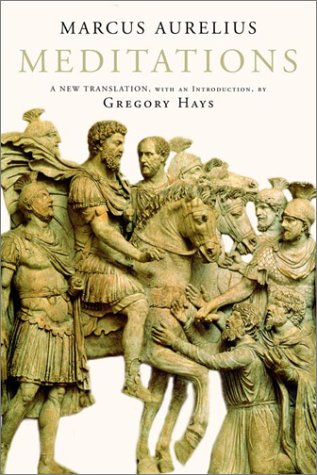 Meditations is a series of philosophical notes which was written by Roman emperor Marcus Aurelius sometime in the 2nd century A.D. That the book has survived for nearly two millennia is amazing. What's even better is that the wisdom of this work - almost every question asked or answered - is still as applicable today. The book (never intended for publication) is written as a series of notes by Marcus to himself. He writes observations, gives himself advice, debates with himself, records insightful observations by others, admonishes and motivates himself.
This is by no means a cohesive or flowing work - the book almost reads like a personal blog. Marcus frequently revisits and circles around a few common identifiable themes throughout the book - the nature of the human mind, body and soul; leadership qualities; how one should react to death; the importance of work and ethics; the impermanence in nature; the insignificance of human acts and lives from a greater perspective; and so on. Yet I found this very style appealing - and very human. It shows how he struggles with himself to avoid and conquer excessive desires, anger, impatience, pride and laziness - problems that I (and many others, I presume) have had to deal with.
There are arguments put forth in the book which really made me sit up, think and take notice; and rethink my life in more ways than one. This is a sponge kind of book - the more you read it, the more you will absorb. There are easily times that you can just read one line and simply think for a good half an hour about it. My favourite line from the book - "Our worth is measured by the things we devote our effort to.".
Definitely a great read for anyone interested in philosophy (and by philosophy I mean practically analyzing people and life) and open to new ideas about living life. This book has also been greatly recommended for leaders and statesmen (Marcus Aurelius was Caesar, after all!).
A brief note: There are many translations of this book available, and some are online. The Gregory Hays translation, however, is the newest in a generation and much more readable than others I tried. He also gives an excellent (if a tad long) introduction to the times and Marcus' life to put the book into context. It was definitely worth the US$10 that I paid for it.
Monday, December 12, 2005
Proof of global warming
The Economist describes scientific arguments that confirm the trend of global warming:
The first, and most basic, is the continuation of the warming trend at the Earth’s surface that has been happening since the early 20th century... the ten years to 2004 were the warmest decade since reliable measurements began in the early 19th century.Meanwhile, as the rest of the world attempts to battle this menace, the most polluting nation stays aloof.
The second result is that the Arctic, a place where any warming trend would be amplified by changes in local absorption of heat as the ice melts, does, indeed, show signs of rapid warming.
...a disagreement between the temperature trend on the ground, which appeared to be rising, and that further up in the atmosphere, which did not. Now, both are known to be rising in parallel.
...the way the world’s oceans have warmed up at different depths... match climate models’ predictions of what happens when warming is induced by greenhouse gases better than it matches predictions of the result of changes in the sun’s activity.
The fifth is the observation in reality of a predicted link between increased sea-surface temperatures and the frequency of the most intense categories of hurricane, typhoon and tropical storm.
...an observation that ocean currents in the North Atlantic are faltering in ways that computer models of the climate previously suggested would happen in response to increased temperatures.
Saturday, December 10, 2005
Google Earth for Mac
Finally, second-class citizens in the Google Universe (Mac users) get Google Earth. Well, depends on how you look at it... I grabbed an unofficial version off the net and ran it - and it works! Here's a screenshot...

It definitely is VERY beta though... if you ask it to auto-go to a site, it virtually kills the rest of the software running on your comp (to the extent that music playing in iTunes sounds broken). Looks like they really have to work on optimizing the thing. Its good to see them working on it though.
It definitely is VERY beta though... if you ask it to auto-go to a site, it virtually kills the rest of the software running on your comp (to the extent that music playing in iTunes sounds broken). Looks like they really have to work on optimizing the thing. Its good to see them working on it though.
The infinite highway?
In the latest MIT hack, some dude painted highway signs on the infinite corridor of MIT yesterday. I was lucky enough to get a few shots. Couldn't divine the purpose though :)

Of course, all of this had disappeared by today :)
Of course, all of this had disappeared by today :)
Friday, December 09, 2005
Dark Moon by David Gemmell
 I had given up. In my mind, a good fantasy story was a project. At least three books, sometimes as many as 11. I had convinced myself that it was probably easier to fully know and enjoy a fantasy series than to read the holy texts and become a Brother of the Latvian Orthodox Church, but not by much.
Then I came up on this book. Gemmell's writing style is flowing and lucid, and the plot of the story rocks. Its about how a warrior with a split personality, a musician possessing ancient magic, a cunning general and a old but brilliant engineer come together to save the world from an invasion by an ancient species. Even though the book is only 500 pages (fantasy readers will know what I'm talking about), the plot is very well developed and definitely gets you thinking. Of course, the plot or characters are not developed with the intensity of Jordan, Salvatore or Eddings, but they get more than one book to do it. Others I know have called the ending a bit abrupt but to me it made perfect sense.
This is definitely a book you can sink into and enjoy in one straight sitting. Regular fantasy fans will definitely enjoy it, but its also a great start for people who've been kept away from fantasy because they see a story that spans eleven books and counting!
Monday, December 05, 2005
FBPNN: Climate change conference is a lot of hot air
Montreal, Canada - The Undecided Nations Organization (UNO) has been holding a climate change conference for past few days here, the prime objective being to cut emissions of greenhouse gases and basically save the planet. As the entire human race watches with hope, delegates to the UNO go about their real agenda - to maintain indecisiveness about anything to do with climate change.
The last major climate change agreement was made in Japan and termed the KYOTO (Keep Yelling Out To Others) Protocol. This piece of international legislation was a model example to of how politicians worldwide could come together and solve the world's biggest problem - how to get campaign funding while still appearing to save the environment. The agreement was designed so that every world leader could claim that his country had been unfairly dealt with in some way, curse the greed of the rest of the world and convince the people's representatives to not ratify the treaty.
The Kyoto Protocol runs out in 2012, and has already begun to show its breaking points. Members of the Exasperated Union (EU), whose populations are known to contain vast amounts of concerned scientists and environmentalists, have already been forced to create their own version of the Kyoto protocol - squabbling over which has already begun.
The Unequalled Snobs of America (USA), has, as always - been completely opposed to any sort of binding climatic agreement. Quidditch prime minister Phony Blair attempted to show the USA in a generous light by suggesting that he believed that "all major countries" would accept legally binding emissions targets. For his troubles, he was snubbed by a minion in the US administration with so little authority that he referred to himself as the "leader of the US delegation to Montreal". Unconfirmed reports from the White House chefs show that the number of bones scheduled to be thrown to the de facto 51st state are to be decreased by fifty percent for two months.
The same minion cited the by-now famous US position on climate change: "We do not believe in taking possibly dangerous economic risks based on a phenomenon for which there is so little evidence. We do not believe in speculative science, whether about global warming or evolution. If you want us to act without evidence, you should probably try and bring us an unfounded rumour about weapons of mass destruction in an oil-rich nation." He went on to defend his country's position on doing their bit for the environment. "We believe in the spirit of voluntary reduction in emissions. By liberating so many of our brothers in the Middle East from tyrant dictators, we've clearly demonstrated what the spirit of volunteering can achieve."
Of course, the USA position on this matter can easily be understood. After all, how can they be expected to help in saving a planet which, according to their Constitution, consists of 95.8% alien lifeforms?
© 2005 Fake But Possible News Network
Thursday, December 01, 2005
Confessions of a linguistic flirt
Father, forgive me, for I have sinned.
Yesterday, I just picked up a new language. My mood was bleak, and maybe I'd had a bit too much coffee to drink. R. Just R. We met in machine learning class, and at first I never imagined I'd be spending any time with R at all - I thought good old MATLAB would work just fine for whatever I needed. And you know how much I hate the "getting to know" part.
I didn't have a choice, Father. I was really in it to cash in on the inheritance. You see, R's predecessor, S had passed on a procedure that I desperately needed to validate some test cases and R and S were the only ones that had it. I chose R because you know I like the younger ones and besides, S is proprietary. However sinful I may be, you know I'd never pay for that kind of thing.
So I took her to my home directory and got started. I got to know R quite well in just one night. My deadline is due soon and I really needed some quick action. Its amazing how little you need to talk to R - something I've never experienced before. The way to speak to R is also primitive (and hedonistic), but it sure produces amazing results. One liners with R go like
but they actually incorporate five long and loopy statements that you'd have to make with any other language! I hear your disapproval, Father. I have also committed the sin of breaking the code law - I know this kind of code is not maintainable, reusable, extendible or readable. But it boosts my programmer's ego so much! And even you have to agree that the code sounds so much alike to words said in the Bibles (GNU Make Manual, 4.14).
Yes, Father, I accept. As penance, I will go and finish properly documenting my older code in C++. And I promise, R will not be more than a one project stand.
Yesterday, I just picked up a new language. My mood was bleak, and maybe I'd had a bit too much coffee to drink. R. Just R. We met in machine learning class, and at first I never imagined I'd be spending any time with R at all - I thought good old MATLAB would work just fine for whatever I needed. And you know how much I hate the "getting to know" part.
I didn't have a choice, Father. I was really in it to cash in on the inheritance. You see, R's predecessor, S had passed on a procedure that I desperately needed to validate some test cases and R and S were the only ones that had it. I chose R because you know I like the younger ones and besides, S is proprietary. However sinful I may be, you know I'd never pay for that kind of thing.
So I took her to my home directory and got started. I got to know R quite well in just one night. My deadline is due soon and I really needed some quick action. Its amazing how little you need to talk to R - something I've never experienced before. The way to speak to R is also primitive (and hedonistic), but it sure produces amazing results. One liners with R go like
reducedX<-X[1:dim(X)[1],A$which[(A$Cp==min(A$Cp[A$size==m+1])) & A$size==m+1,1:dim(X)[2]]]but they actually incorporate five long and loopy statements that you'd have to make with any other language! I hear your disapproval, Father. I have also committed the sin of breaking the code law - I know this kind of code is not maintainable, reusable, extendible or readable. But it boosts my programmer's ego so much! And even you have to agree that the code sounds so much alike to words said in the Bibles (GNU Make Manual, 4.14).
Yes, Father, I accept. As penance, I will go and finish properly documenting my older code in C++. And I promise, R will not be more than a one project stand.
Subscribe to:
Posts (Atom)