Tuesday, December 27, 2005

The Christmas of code

I was mostly working through Christmas. As opposed to the popular public celebrations in Asia during this time, most of America seems to celebrate X'mas at home with family and the streets are all but deserted. The Yuletide spirit did, however, rain down a lot of programming goodies onto me.

I had been searching forever for a good math library for C++ which could provide me things like probability distribution tables, linear algebra and the like, and a couple of days ago I discovered the GNU Scientific Library (GSL). Its an extremely thorough, well-documented and well-implemented library (in terms of API) for C/C++. Its a huge surprise this doesn't turn up if you google for c++ statistical library or c++ numeric computing. It has routines for all kinds of scientific computations from Fast Fourier Transforms to Statistical Distributions to Monte Carlo Integration. An amazing find. Shouldn't they be required to tell you about such stuff in graduate school, if not as an undergraduate?

I finally made myself reasonably conversant with creating Makefiles for gcc. Creating makefiles for your project manually however is difficult since the dependencies inside your code may change and thus play havoc with incremental builds. I could not, however, make myself learn autoconf and automake - for which there's a whole book - next to which the GNU Make manual looks like a short story. I decided instead to try and write a small piece of software which would generate makefiles automatically for simple projects. I ended up writing a small bash script, which I call buildmake, which basically does what I need - takes a bunch of cpp files, resolves header file dependencies and creates a makefile for incremental builds. If you're into that sort of thing, you can check it out here.

To complete the trio, I had been frustrated in my attempts to get Mac OS X to link static libraries with programs (I know, dynamic libraries are the "in" thing, but you try and convince your cluster administrator to give you access to /usr/lib); and I finally figured out the problem which left me kicking myself and (nearly) my laptop. Turns out that for Apple's GCC, the order of linking is important: gcc -lsomelib code.c will not work, but gcc code.c -lsomelib will. Now, I had tried to export environment variables, copy libraries to all sorts of places, explored unchartered GCC flags, but who would have thought of that! And nope, Google is not your friend if you have this problem either - found this nugget of information in what has now become my favourite book, despite the cheesy name - Mac OS X Tiger for Unix geeks.

Hope you all had a merry Christmas!

Thursday, December 22, 2005

Writing a final at MIT

For the first (and likely the last) time today, I took a final exam in MIT.

There was four subjects being examined in the same examination hall, which was inside a large indoor basketball court - very much like some exam halls in NTU (Singapore). There, the similarities end.

MIT admin staff probably select the oldest tables that can still be held together for students to give exams on. I must admit though, it was a pretty large table - about the size of a small dining table for six - and there was a table and two chairs per person. The top of my table had hundreds of marks from geometrical figures to a scrawled "JAK SPAROW WUZ 'ERE" (I sure hope he didn't have an English exam). The metal lining on the side of the top of the table was held together by duct tape in some places. They make sure you'll buy the "Estd. 1861" line. And the tables rocked. Rocked, squeaked and creaked as I wrote on them - matching every stroke of my pen. Sure was a good way to mask the nervous shivering while writing the paper!

A 9 AM exam in Singapore means students get in by 8.30 and there is usually pin-drop silence by 8.45 when the papers start being distributed. At 9 AM today, most students were having breakfast on the aforementioned tables. Coffee, yoghurt and bagels were the most popular choices. One guy was sitting surfing on his laptop, the staff (lecturer and TAs) had just about come and settled down. I was already beginning to like the atmosphere (except that I was feeling hungry and had never dreamed of getting breakfast to an exam hall).

One girl walked in to the exam hall dragging one large and one medium trolley suitcase behind her. Someone asks the question that was begging to be asked, "open book exam?" Turns out it was, but the suitcases were because she was flying home about one hour after the exam.

In NTU, before every exam used to come a 15 minute speech, which in my head had earned the nickname "All Students' License Agreement". It went something like, "No paper, book, document, picture or other referral device may be brought into the exam hall unless specified under..." Out here, our lecturer looked left, looked right and yelled, "I guess you guys can start". Then, realizing her mistake, said, "Only for my subject!"

After that, of course, as with all exams, the outside world ceased to exist for a couple of hours. There was one interesting thing in the paper, though. At one point, the lecturer had been kind enough to mention, "The next two questions are very hard. Don't burn your time on them if you can't see the solution." Very kind of you, but did you imagine the rest of the paper was easy?

Wednesday, December 21, 2005

Why Macs are better than PCs

The Inquirer has an interesting argument to make:
Apple, the long forgotten subject of this article, is different. It doesn't compete against anything at all. The industrial design focus group is one turtleneck wielding man, not a watered down group of suburban housewives who fit into income category 12A, or teens in the hip-hop demographic. Nope, Apple needs to please one person.
Very true, in my opinion - and speaking from personal experience - the reason why I stay away from any PC company. If I want a Windows/Linux box, I go out, buy the components and build it myself.

Probably 70% of the market believes that all that matters in a CPU is speed; 85% of the market cares more about price than a good sound card; 90% don't know how much of a difference a good power supply can make and 99% probably don't know that hard disks come with different cache sizes. But I do. Which is why buying a PC is never easy as Dell.

Tuesday, December 20, 2005

No longer favourites

What began as mild irritation last night has grown into serious ire. The del.icio.us social bookmarking site has been down for almost 15 hours now. I rely heavily on it for managing my bookmarks. The "latest links" section on the sidebar of my blog is tied to it; but the loss of that is a minor annoyance. The major annoyance is having to search Google for sites related to research and coding that I'd bookmarked online, thinking that saving them online was the safest option.

I'm thinking of moving onto other similar services (notably Simpy), but now that this has happened, I'll have to figure out a way to keep synchronizing with a given online service regularly to keep a backup of my latest bookmarks.

On a side note, the guys at delicious claim that a "power outage" caused various problems with their service, including corruption and crashing of slave/redundant servers, and last night they decided to put everything offline to rebuild their indexes. I'm not sure if this is a process that should take as long as 15 hours, if you'd set up things correctly in the first place.

Whats more interesting is that this happened right after Yahoo! acquired del.icio.us, and I wonder if the increased load from the announcement and interest led to the current problems as opposed to pure power outages.

In any case, a lesson learned, the hard way.

[Update] Del.icio.us is back on line. For those like me who didn't bother to create a backup, Foxylicious is a Firefox extension that creates a local backup of delicious bookmarks.

Saturday, December 17, 2005

FBPNN: Toward free and fair selections

Miracles do happen. The entire Indian Parliament has come to a unanimous agreement about an issue - the dropping of former India captain Sourav Ganguly from the third test against Sri Lanka to be played at Ahmedabad starting Sunday. It is reported that the Prime Minister nearly had a heart attack on hearing that the Left Front had actually supported his call to table the issue in the Lazy Old Keepers of Solid Anarchy on Benches of Hysterical Antics (LOK SABHA).

It was decided that the Parliament shall devote every possible resource to ensure that the Board of Cricketing Chaos in India (BCCI) doesn't stoop to dirty politics and ignore its real job. To this end, the Election Commission of India shall now be reinstated as the Selection Commission of India.

Representatives of this body will now control both the voting and decision making procedures at the BCCI using new innovative methods. One recent breakthrough is a pill developed by Ranbaxy Industries which genetically modifies neurons in the brain to induce selective amnesia in the recipient. Such a pill shall be given to the top selectors and will, theoretically, ensure that they forget which state in India they come from. An anonymous source at Ranbaxy, however, was not very optimistic. "What we've proven is that this medication is extremely effective in altering the genetic structure of neuron cells in the brain." But for it to work well, he said, "it is necessary for the host organism to possess neurons in a certain minimum quantity."

The opposition leader demanded in Parliament today that the matter be raised in the UN security council and a team be sent to monitor this process to ensure free and fair selections. "The human rights of a billion people are at stake", he said. "How can we live in a world where sports teams are selected with such injustice."

Speaking at a joint press conference, Somnath Chatterjee, Pranab Mukherjee, Buddhadeb Bhattacharya (the leaders who pushed the issue through) said that they were proud that to have taken this step to ensure the safety, security and well-being of every Indian. When asked how democratic elections in India would be held now, they replied, "Lets deal with one problem at a time. Lets talk about future elections, the cold wave in North India, violence in Kashmir, defense acquisitions, rural healthcare and all those other issues later. We will never get anywhere as a nation if we don't get our priorities right."

FBPNN is the Fake But Possible News Network 2005. While we make every effort to ensure that nothing in our reports is true, the ridiculousness of human behavior remains a step ahead; and therefore the complete lack of truth in this article cannot be guaranteed.

Friday, December 16, 2005

What should you do with your life?

If you read one article on the Internet today, let it be this one. A real insight for anyone who has struggled with finding the right career, and a real eye-opener for anyone who hasn't.

[via Sherene's blog]

Thursday, December 15, 2005

Meditations by Marcus Aurelius (Translator: Gregory Hays)

Meditations is a series of philosophical notes which was written by Roman emperor Marcus Aurelius sometime in the 2nd century A.D. That the book has survived for nearly two millennia is amazing. What's even better is that the wisdom of this work - almost every question asked or answered - is still as applicable today. The book (never intended for publication) is written as a series of notes by Marcus to himself. He writes observations, gives himself advice, debates with himself, records insightful observations by others, admonishes and motivates himself.

This is by no means a cohesive or flowing work - the book almost reads like a personal blog. Marcus frequently revisits and circles around a few common identifiable themes throughout the book - the nature of the human mind, body and soul; leadership qualities; how one should react to death; the importance of work and ethics; the impermanence in nature; the insignificance of human acts and lives from a greater perspective; and so on. Yet I found this very style appealing - and very human. It shows how he struggles with himself to avoid and conquer excessive desires, anger, impatience, pride and laziness - problems that I (and many others, I presume) have had to deal with.

There are arguments put forth in the book which really made me sit up, think and take notice; and rethink my life in more ways than one. This is a sponge kind of book - the more you read it, the more you will absorb. There are easily times that you can just read one line and simply think for a good half an hour about it. My favourite line from the book - "Our worth is measured by the things we devote our effort to.".

Definitely a great read for anyone interested in philosophy (and by philosophy I mean practically analyzing people and life) and open to new ideas about living life. This book has also been greatly recommended for leaders and statesmen (Marcus Aurelius was Caesar, after all!).

A brief note: There are many translations of this book available, and some are online. The Gregory Hays translation, however, is the newest in a generation and much more readable than others I tried. He also gives an excellent (if a tad long) introduction to the times and Marcus' life to put the book into context. It was definitely worth the US$10 that I paid for it.

Monday, December 12, 2005

Proof of global warming

The Economist describes scientific arguments that confirm the trend of global warming:
The first, and most basic, is the continuation of the warming trend at the Earth’s surface that has been happening since the early 20th century... the ten years to 2004 were the warmest decade since reliable measurements began in the early 19th century.

The second result is that the Arctic, a place where any warming trend would be amplified by changes in local absorption of heat as the ice melts, does, indeed, show signs of rapid warming.

...a disagreement between the temperature trend on the ground, which appeared to be rising, and that further up in the atmosphere, which did not. Now, both are known to be rising in parallel.

...the way the world’s oceans have warmed up at different depths... match climate models’ predictions of what happens when warming is induced by greenhouse gases better than it matches predictions of the result of changes in the sun’s activity.

The fifth is the observation in reality of a predicted link between increased sea-surface temperatures and the frequency of the most intense categories of hurricane, typhoon and tropical storm.

...an observation that ocean currents in the North Atlantic are faltering in ways that computer models of the climate previously suggested would happen in response to increased temperatures.
Meanwhile, as the rest of the world attempts to battle this menace, the most polluting nation stays aloof.

Saturday, December 10, 2005

Google Earth for Mac

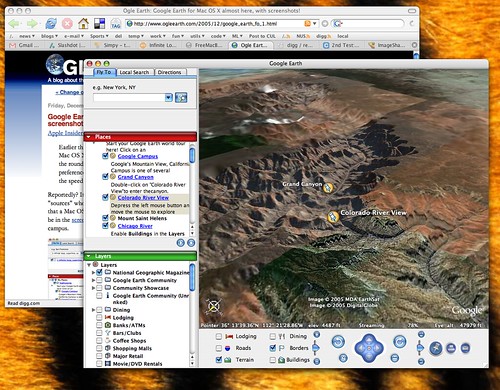
Finally, second-class citizens in the Google Universe (Mac users) get Google Earth. Well, depends on how you look at it... I grabbed an unofficial version off the net and ran it - and it works! Here's a screenshot...

GoogleEarthMac

It definitely is VERY beta though... if you ask it to auto-go to a site, it virtually kills the rest of the software running on your comp (to the extent that music playing in iTunes sounds broken). Looks like they really have to work on optimizing the thing. Its good to see them working on it though.

The infinite highway?

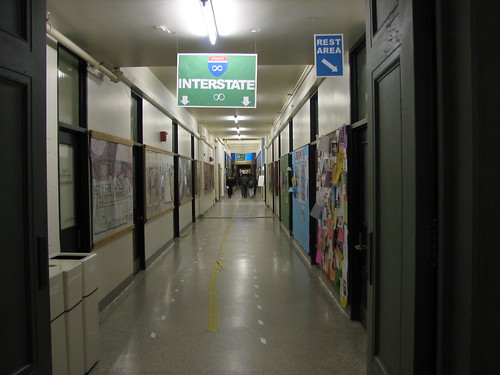
In the latest MIT hack, some dude painted highway signs on the infinite corridor of MIT yesterday. I was lucky enough to get a few shots. Couldn't divine the purpose though :)

Interstate infinity

Of course, all of this had disappeared by today :)

Friday, December 09, 2005

Dark Moon by David Gemmell

I had given up. In my mind, a good fantasy story was a project. At least three books, sometimes as many as 11. I had convinced myself that it was probably easier to fully know and enjoy a fantasy series than to read the holy texts and become a Brother of the Latvian Orthodox Church, but not by much.

Then I came up on this book. Gemmell's writing style is flowing and lucid, and the plot of the story rocks. Its about how a warrior with a split personality, a musician possessing ancient magic, a cunning general and a old but brilliant engineer come together to save the world from an invasion by an ancient species. Even though the book is only 500 pages (fantasy readers will know what I'm talking about), the plot is very well developed and definitely gets you thinking. Of course, the plot or characters are not developed with the intensity of Jordan, Salvatore or Eddings, but they get more than one book to do it. Others I know have called the ending a bit abrupt but to me it made perfect sense.

This is definitely a book you can sink into and enjoy in one straight sitting. Regular fantasy fans will definitely enjoy it, but its also a great start for people who've been kept away from fantasy because they see a story that spans eleven books and counting!

Monday, December 05, 2005

FBPNN: Climate change conference is a lot of hot air

Montreal, Canada - The Undecided Nations Organization (UNO) has been holding a climate change conference for past few days here, the prime objective being to cut emissions of greenhouse gases and basically save the planet. As the entire human race watches with hope, delegates to the UNO go about their real agenda - to maintain indecisiveness about anything to do with climate change.

The last major climate change agreement was made in Japan and termed the KYOTO (Keep Yelling Out To Others) Protocol. This piece of international legislation was a model example to of how politicians worldwide could come together and solve the world's biggest problem - how to get campaign funding while still appearing to save the environment. The agreement was designed so that every world leader could claim that his country had been unfairly dealt with in some way, curse the greed of the rest of the world and convince the people's representatives to not ratify the treaty.

The Kyoto Protocol runs out in 2012, and has already begun to show its breaking points. Members of the Exasperated Union (EU), whose populations are known to contain vast amounts of concerned scientists and environmentalists, have already been forced to create their own version of the Kyoto protocol - squabbling over which has already begun.

The Unequalled Snobs of America (USA), has, as always - been completely opposed to any sort of binding climatic agreement. Quidditch prime minister Phony Blair attempted to show the USA in a generous light by suggesting that he believed that "all major countries" would accept legally binding emissions targets. For his troubles, he was snubbed by a minion in the US administration with so little authority that he referred to himself as the "leader of the US delegation to Montreal". Unconfirmed reports from the White House chefs show that the number of bones scheduled to be thrown to the de facto 51st state are to be decreased by fifty percent for two months.

The same minion cited the by-now famous US position on climate change: "We do not believe in taking possibly dangerous economic risks based on a phenomenon for which there is so little evidence. We do not believe in speculative science, whether about global warming or evolution. If you want us to act without evidence, you should probably try and bring us an unfounded rumour about weapons of mass destruction in an oil-rich nation." He went on to defend his country's position on doing their bit for the environment. "We believe in the spirit of voluntary reduction in emissions. By liberating so many of our brothers in the Middle East from tyrant dictators, we've clearly demonstrated what the spirit of volunteering can achieve."

Of course, the USA position on this matter can easily be understood. After all, how can they be expected to help in saving a planet which, according to their Constitution, consists of 95.8% alien lifeforms?

© 2005 Fake But Possible News Network

Thursday, December 01, 2005

Confessions of a linguistic flirt

Father, forgive me, for I have sinned.

Yesterday, I just picked up a new language. My mood was bleak, and maybe I'd had a bit too much coffee to drink. R. Just R. We met in machine learning class, and at first I never imagined I'd be spending any time with R at all - I thought good old MATLAB would work just fine for whatever I needed. And you know how much I hate the "getting to know" part.

I didn't have a choice, Father. I was really in it to cash in on the inheritance. You see, R's predecessor, S had passed on a procedure that I desperately needed to validate some test cases and R and S were the only ones that had it. I chose R because you know I like the younger ones and besides, S is proprietary. However sinful I may be, you know I'd never pay for that kind of thing.

So I took her to my home directory and got started. I got to know R quite well in just one night. My deadline is due soon and I really needed some quick action. Its amazing how little you need to talk to R - something I've never experienced before. The way to speak to R is also primitive (and hedonistic), but it sure produces amazing results. One liners with R go like

reducedX<-X[1:dim(X)[1],A$which[(A$Cp==min(A$Cp[A$size==m+1])) & A$size==m+1,1:dim(X)[2]]]

but they actually incorporate five long and loopy statements that you'd have to make with any other language! I hear your disapproval, Father. I have also committed the sin of breaking the code law - I know this kind of code is not maintainable, reusable, extendible or readable. But it boosts my programmer's ego so much! And even you have to agree that the code sounds so much alike to words said in the Bibles (GNU Make Manual, 4.14).

Yes, Father, I accept. As penance, I will go and finish properly documenting my older code in C++. And I promise, R will not be more than a one project stand.

Tuesday, November 29, 2005

"Reforms" in Bihar

Is there something about the air in Bihar? Is it forever doomed to be ignored by its rulers? Rediff writes about Nitish Kumar:
Vowing to change "the worst ever work culture due to Rashtriya Janata Dal's misgovernance for past 15 years", he told reporters that he would have a one-to-one meeting with senior bureaucrats, including secretaries of all departments and officers of the rank of inspector general and above to improve the situation.
The Indian Express writes about the professional efforts of his cabinet to establish a good work culture:
Cabinet minister Baidyanath Mahto’s men went and ‘‘booked’’ a sprawling bungalow on Bailey Road, occupied for 15 years by RJD’s former minister Iliyaas Hussain. Using a red chalk, they wrote ‘‘Baidyanath Mahto, Cabinet minister’’ alongside Hussain’s nameplate. It was to pre-empt other leaders from taking the house. But later, another Cabinet minister Monazir Hassan, who has been given charge of the building construction department, was allotted the same bungalow. Mahto had no option but to withdraw his claim.
I remember being as childish - booking the school bus window seat just behind the driver in Std I. Good luck, Bihar.

Monday, November 28, 2005

FBPN Network: Spammers may be helping humanity

Blogsville, The Internet - New scientific evidence shows how spammers may have helped a large number of patients suffering from Alzheimer's disease. Active brain function, scientists say, greatly help reduce the risk of Alzheimer's disease and may even help reverse it.

However, societal efforts to stop us from using our brains have greatly increased in the last few decades. The invention of the television pioneered this movement and soon after, people stopped using their brains at home. The Internet age followed and people stopped using their brains at work as well.

The Bureau Of Largely Lame Ostriches Creating Kaleidoscopic Statistics (BOLLOCKS) estimates that people who have Internet access at work use their brains about 1% of the time. The people who do not have Internet access at work use their brains at work about 60% of the time, but 90% of that usage is geared toward figuring out a way to access the Internet through the corporate firewall.

Recent emergent studies have concluded that spammers actually started out as a movement to fight sinister efforts to get humans to stop using their neurons (why our governments would want to do such a thing is another story). Spamming was initially directed towards diluting Internet content to move users away from the brain-numbing expanses of the Internet. Originally, it was targeted toward services like e-mail - which was a concept doomed from the start. Our heroes of humanity had never thought that people would actually be dumb enough to believe spam-content for reality.

Spamming blogs, on the other hand, has proved much more effective in achieving the true objective of the spammers. BOLLOCKS estimates between 40 and 70 percent of office time is spent reading and commenting on blogs. To help "fight" spam, blogging sites and software frequently generate fudged-up images of random sequences of letters (much like the one reproduced to the right). An experiment conducted by doctors at the Barvard School of Medicine shows that although it stays minimal while reading a blog or leaving comments, neural activity spikes up greatly while trying to read the anti-spam verification images. This is probably due to the pattern-recognition nature of the task as well as the fact that the images get tougher with time as the spammers make better and better programs to automatically read the images. For the first time in history, masses of humans are being forced to use their brains more efficiently than central processing units.

Scientists estimate that reading and commenting on twenty-six point two blogs with the image verification feature generates brain activity equivalent to doing a crossword, which in turn is the prescribed activity for patients considered to be at risk for Alzheimer's. The next time you see spam, you may want to see it in a slightly kinder light.

P.S. FBPN stands for "Fake but Possible News". I would have called it Fake News, but I wouldn't want to be sued by these guys.

P.P.S. This FBPN Network story is its first output. Depending on the laziness of its employees (which number in the low ones), it may or may not be the last.

Friday, November 25, 2005

God's Debris by Scott Adams

Scott Adams recently released a free PDF of his book, God's debris. Its a wonderful book with a number of new ideas. Just one read won't quite be enough for me, though. There are a lot of new ideas in the book - new ways to think about life. It kind makes you think the universe has turned upside down. Some of the ideas are present in other philosophies, but the idea that really makes me think is his concept that God is basically probability.

Einstein once said, "God does not play the dice". I wonder how he would have reacted to the statement that "God is the dice."

Anyone with an open mind will love the book. To a pragmatic, rigidly scientific person however, this book might seem just a combination of mysticism and cult. Here's a snippet from the book, which should help you figure out whether you'll like it or not:
"There is no logical limit to how
much our collective power will grow. A billion years from
now, if a visitor from another dimension observed human-
ity, he might perceive it to be one large entity with a con-
sciousness and purpose, and not a collection of relatively
uninteresting individuals.”

“Are you saying we’re evolving into God?”

“I’m saying we’re the building blocks of God, in the
early stages of reassembling.”

“I think I’d know it if we were part of an omnipotent
being”.

“Would you? Your skin cells are not aware that they are
part of a human being. Skin cells are not equipped for that
knowledge. They are equipped to do what they do and
nothing more. Likewise, if we humans—and all the plants
and animals and dirt and rocks—were components of God,
would we have the capacity to know it?”

“So, you’re saying God blew himself to bits—I guess
that was the Big Bang—and now he’s piecing himself back
together?”

“He is discovering the answer to his only question.”

Thursday, November 24, 2005

The Gladiator

Enjoying a movie to me is all about two things... the dialogue and the pauses between the dialogue. Maybe thats why I really appreciate so few movies.

I watched Gladiator after a long time today, and its still as wonderful a movie as I remember it - every slightest touch in the movie speaks of brilliance. It counts among the three movies I'd ever rate as 10/10; the other two being "The Empire Strikes Back" and "The Matrix".

Some of the most memorable moments in the Gladiator... not just for the words, but the silences between them:
Maximus: What we do in life echoes in eternity.

Marcus Aurelius: Tell me again, Maximus, why are we here?
Maximus: For the glory of the Empire, sire.

Marcus Aurelius: There was a dream that was Rome. You could only whisper it. Anything more than a whisper and it would vanish, it was so fragile.

Marcus Aurelius: How can I reward Rome's greatest general?
Maximus: Let me go home.
Marcus Aurelius: Ah, home.

Marcus Aurelius: Won't you accept this great honor that I have offered you?
Maximus: With all my heart, no.
Marcus Aurelius: Maximus, that is why it must be you.

Gracchus: The beating heart of Rome is not the marble of the Senate, it's the sand of the Colosseum. He'll bring them death and they will love him for it.

Gracchus: I don't pretend to be a man of the people. But I do try to be a man for the people.

Maximus: My name is Maximus Decimus Meridius, commander of the Armies of the North, General of the Felix Legions, loyal servant to the true emperor, Marcus Aurelius. Father to a murdered son, husband to a murdered wife. And I will have my vengeance, in this life or the next.

Maximus: There was a dream that was Rome. It shall be realized. These are the wishes of Marcus Aurelius.

Wednesday, November 23, 2005

The Collected Short Stories - Jeffrey Archer

This was an Archer that I had missed. One of his best, which makes me unhappy that I've only just read it; but happy that I left it for this time, when I really have little else this good to serve for entertainment. This book easily becomes my favourite Jeffery Archer.

I'd rate almost every short story in the book as 4/5 or better. My favourites were "Broken Routine", "Old Love", "Just good friends", "Christina Rosenthal" and "One man's meat...". The beauty of a well-written short story is not just that it drives home a point in just a few pages; but that its message is usually something very simple yet impactful - whether its about friendship, laughter, achievement or ego. In books like "First Among Equals" or "Not a Penny More, Not a Penny Less" I was awed by the intricacies and magnitude of the plot - but in this book, what delighted me that even the simple plots were equally powerful and immersive - thirty-six times over.

I guess almost everyone must have read this by now, but if you haven't do read it!

Tuesday, November 22, 2005

Grandfather browser

I'm almost embarassed to admit it, but I've taken to using Lynx very often. For those who don't know, Lynx is a text browser. All you get is pure ASCII. No images, single font, single size. I use it mostly for reading research related stuff. I've found (empirically) that it offers quite a few advantages.

Mostly, it helps me focus. Of course, I access Blogger in Firefox, where right now I have about eight tabs open, with at least half being completely work-unrelated (cricket scores, PhD comics, Indian Express and so forth). Where there is a tab, there is a switch to it once in a while, which can be hugely distracting.

At a deeper level, though, in a text browser its really difficult to go to any external links - even those that are there in a particular page. There's no easy way of opening them while keeping your current page (no new tab/new window... and if you know of one, don't tell me!) so you really tend to (a) open pages that you will read and (b) stay focused on reading them. Moreover, links don't stand out as much as they do in a graphical browser, they're just blue in colour as opposed to black. I even read a few blogs on it these days - I've been noticing that in a tabbed or graphical interface I sometimes tend to just gloss over the information rather than really reading it.

I cannot emphasize how nice it can be to have just one font. One gets tired of big, small, italicized, colored, imaged and generally distorted text at times. Console font can be a blessing.

Lastly, it really is the best solution for ad-blocking - of course!

Of course, Lynx never will replace a graphical browsing interface - but I find myself pretty happily spending an hour or so on it continuously at times. Trust me, if you intend to get through the GNU Make Manual in two or three (or even one!) sitting straight, Firefox is probably not your best choice.

Think I might have finally crossed the line into insanity? I can't blame you :)

Monday, November 21, 2005

Jedi Kids

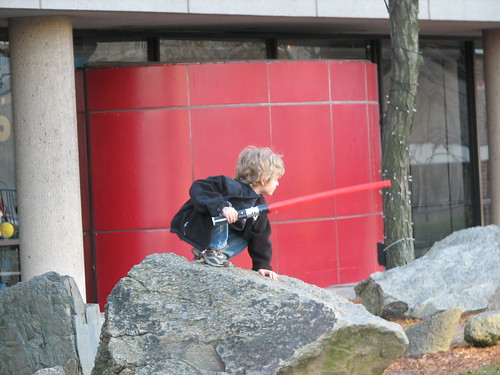
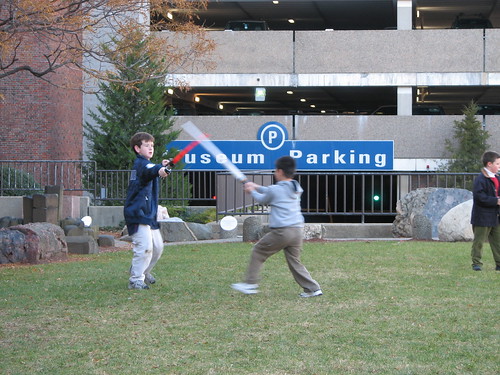
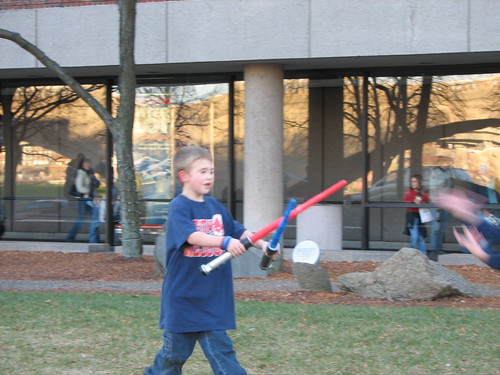
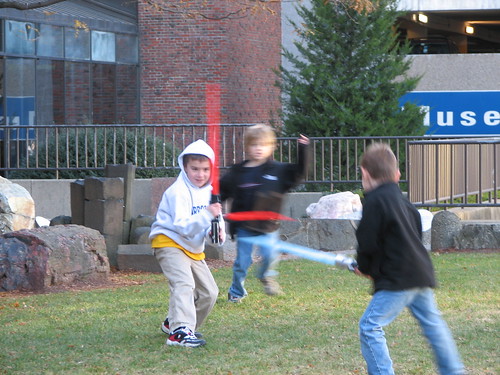
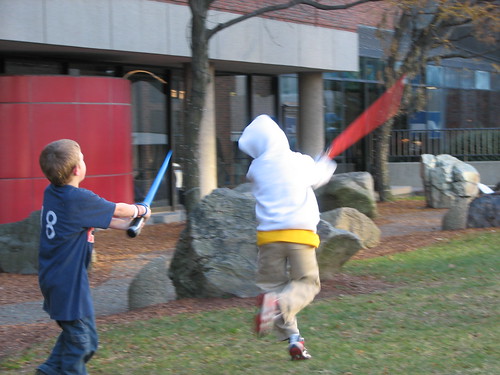
The Boston Museum of Science is running a Star Wars exhibit until April next year. I stopped outside the museum to watch some Padawans exercising with their lightsabers.

IMG_0642.JPG
You refer to the prophecy of the One who would bring balance to the Force. You believe its this... boy?

Padawans 1
You have learned much, young one

Anakin Jr
Kill him, Anakin! Do it now!

Turned
If you're not with me...

IMG_0645.JPG
Sith Lords are my speciality...

IMG_0648.JPG
Luke... NO! I AM YOUR FATHER!!!

Aah.. to be a kid again. In any case, I'm definitely getting one of 'em lightsabers for myself!